Showing posts with label Parent FAQs. Show all posts

Wednesday, December 21, 2016

Parent FAQs: What should I buy my child for Christmas?

I know this is a bit late in the game, but I've been getting this question a lot, and if you are like me, you make heavy use of Amazon Prime the last few days before the holidays.  So, here goes!

Will's first Christmas (in 2014) was sure exciting!
As I'm sure will come as no surprise based on my last post, my #1 recommendation is . . .

Books! 

Books may feel old-fashioned, or too educational, or too low tech, but they aren't too expensive, don't need batteries, travel well, are easy to store, and last for a long time.  Giving books as gifts emphasizes that they are special and deserve to be treasured.  We give Will books as gifts for every birthday and holiday:
The Easter Bunny is a total nerd.

The issue we run into is that we already own a lot of books, and we make generous use of our local library, so it's not clear what books we are worth purchasing.  We want to chose books that Will will love, treasure, and remember fondly, without spoiling him and buying him dozens of books he will never read. So, here are few guidelines I use to choose books as gifts for Will. 

Books that we have checked out from the library again and again.  There are few library books that Will is never willing to say goodbye to.  This starts to feel unfair to the other kids, plus these books have become part of our memories of this year, so Will will get a few brand-new copies of his favorites to unwrap on Christmas: This is Paris, A B See, and Snow. (Note: this works best if you have returned them to the library at least few weeks before the gifting. Will has been asking about some of his favorites, and he understands that someone else is reading them now, so he will be thrilled to get them back!)
We like to test-drive books before buying them!
Books we can't get at the library.  Will loves This is Paris, but the other books by the same author aren't available at our library, so we giving Will This is New York.


Books that are out of print.  One of Will's favorite library books this year was Susan Jeffers' beautiful Hansel and Gretel. She has illustrated many gorgeous fairy tales and songs, and Will finds her work mesmerizing. However, many of her classics are out of print, so this year Will is getting a used copy of her Thumbelina before it's gone for good!  Note: I believe it's perfectly fine, even lovely, to give children used books as gifts!  Books don't have to be brand new and expensive; children will love them and wear them out anyway.  I buy used books at used books stores, library sales, garage sales, on Amazon, etc.


Books about holidays.  We have a collection of Christmas books that we add to a little every year.  These books are put away most of the year, and we read them before bed only during the holidays. This was a family tradition for me growing up and my father continues it with Will when we are together. I've always remembered those books fondly and I'm glad we still own them so we can continue the tradition. In addition, it's pretty hard to get seasonal books from the library during the right seasons!  Our current favorites include How the Grinch Stole Christmas, Rudolph the Red-Nosed Reindeer, Christmas Mice, Olivia Helps with Christmas, and our family treasury is The Norman Rockwell Christmas Book.
My dad reading Will his nightly Christmas story


Books that reflect our values. This year, we feel more passionate than ever before that we provide Will with books that reflect the diversity of our global society. We include in this category books about traveling to other countries, books in other languages, books that highlight, not hide, our nation's history, and books that feature main characters that don't look the same way we do or have our privileges. Some of my favorites in this category are Gorrion del Metro,  Henry's Freedom Box, and Last Stop on Market Street. I recommend The Coretta Scott King Award page for more great books that are often overlooked.
We have counting books in several languages.

Other Great Gifts


  • Sidewalk chalk.  If you live in a cold snowy place, like we do, you can include a small hand-held chalkboard, or paint chalkboard paint on a wall or table so you can enjoy sidewalk chalk all year. I find the sidewalk chalk works better for little ones than traditional chalk, which they tend to break.
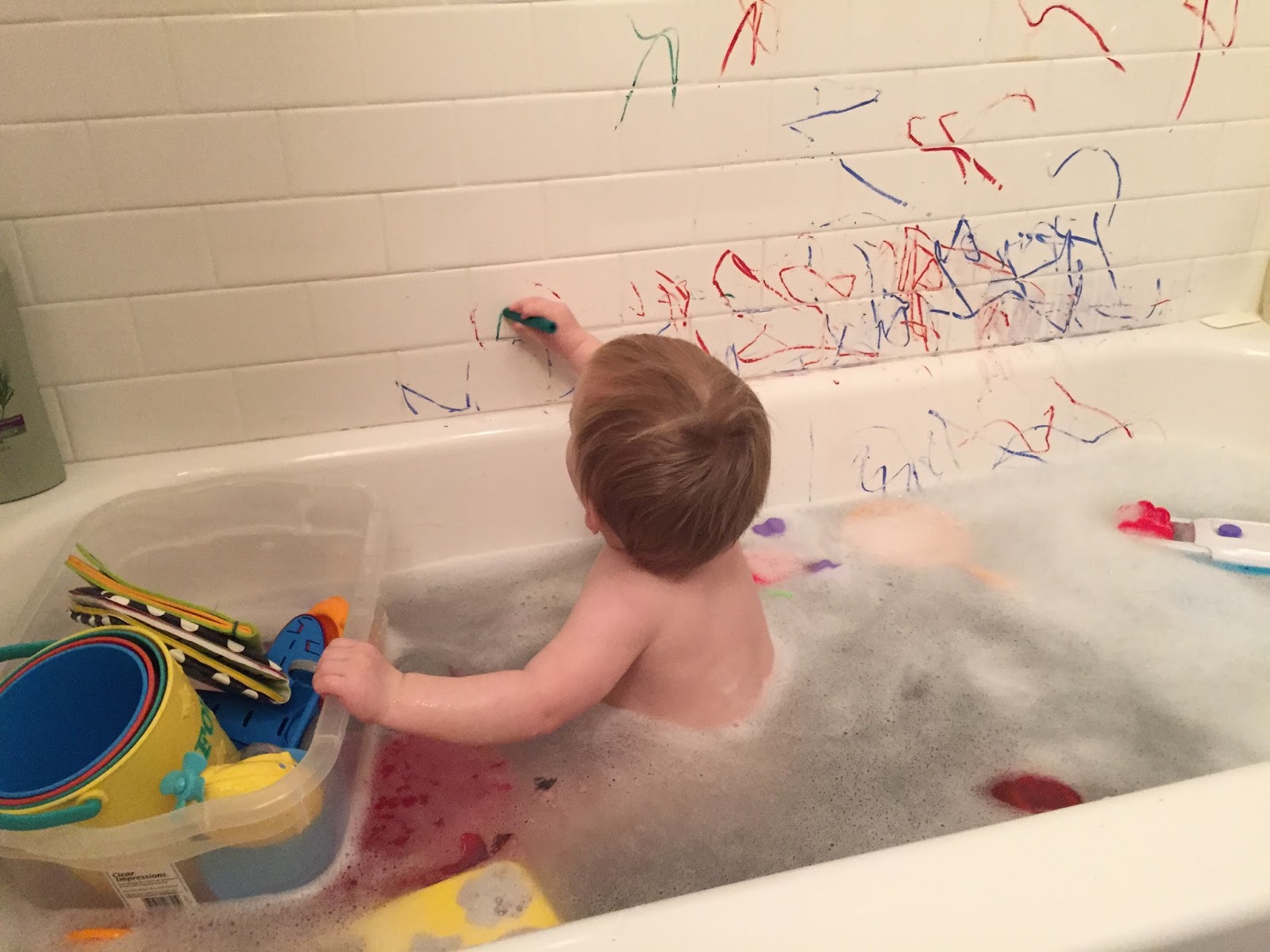
  • Bathtub crayons! Seriously this was the best thing we got Will last year other than books.  He used every crayon until it was tiny nub.
  • Crayons, markers, and fun things to write on.  I like these huge post it notes for displaying Will's work!
  • An alphabet puzzle or magnetic letters.  Will loves to play with the letter pieces in his alphabet puzzle. Sometimes we copy or trace them, sometimes we look for them in books, and sometimes we load them into his toy garbage truck to take them to the dump.  

Will is using his puzzle letters to start to work on matching letter sounds to key words.
Finally, my recommendation is to buy things that are not expensive, don't have batteries or need to be charged, and don't make noise.  One of my favorite Christmas stories growing up was Laura Ingalls Wilder's "Mr. Edwards Meets Santa Claus," which ends:

"Think of having a whole penny for your very own. Think of having a cup and a cake and a stick of candy and a penny. That was a happy Christmas."

The best literacy gifts are not the gifts themselves, but interactions and memories with you and your loved ones over the holidays and make lasting memories. Happy Holidays from our family to yours!

Happy Holidays!


Sunday, October 30, 2016

FAQ: What Books Should I Read to My One-Year-Old?

A friend recently sent me this question: What books do your recommend for 12-18 month-olds?

This is such a good question. The fact is, picking out books that appeal to your child at this stage is tricky!

Age 0-1 is The Easy Part

When babies are very young, in the first year or so, they are used to sitting still, cuddling, and listening to your voice -- it's all they do. So, when you read a book, it's a different variety on that same activity. It doesn't really matter what you read, because they are still developing the basic concept of books and reading and don't really follow the plot. Very young children can't even focus on the pictures yet! So, the important thing at this age is hearing the rhythms of your voice, hearing new vocabulary, and feeling close to you. In his first year, I read Will whatever I found interesting, including all my childhood favorites, a huge book of fairy tales, all the Winnie-the-Pooh books, an anthology of Greek and Roman myths, and even The New Yorker.  Sometimes he would get restless and we'd stop, but mostly he just listened. We got thousands and thousands of words in that year!
Make Way For Ducklings; Will at 4 weeks.
Winnie-the-Pooh; Will at 4 months

Age 1-2 is Much Trickier

By the time children turn one, however, things have changed. They are much more active at this age, walking, exploring, and manipulating all kinds of objects and toys, so sitting quietly is often not a big part of your routine anymore. At the same time, they haven not yet developed strong listening comprehension skills and long attention spans that will allow them to really follow and enjoy stories. As a result, I often hear from parents that their kids at this age "just don't really like reading." They've tried it, and it didn't go that well, so they give it a rest, planning to get back to it when their kids are older and can pay attention. Either that, or they read the same two or three books every night at bedtime, and it's a comforting routine, but it's not that much fun for kids or parents.

This reaction makes sense -- after all, kids will be better able to enjoy and appreciate books when they are older and have longer attention spans, right? Well, yes and no. The fact is, listening comprehension does require attention, but it is also a skill that your child builds over time. So, the more books you read now, the faster their attention spans for reading will develop.

Simply put, reading books prepares children to read more books.


So, my recommendation is to keep at it, even when the going gets tough. Here are a kinds of books that worked for us from age one to two:

Board books. We often think of board books as "baby's first books", but it was not until Will turned one that I really started to appreciate board books as an art form. A good board book has bright, clear, evocative illustrations and just a little text per page. Kids can participate in the reading experience by turning the pages, simultaneously developing their print concepts.

Will's absolute number one favorite at this age was Harry the Dirty Dog, by Gene Zion. We just happened to find this board book at TJ Maxx a few weeks before Will's first birthday, and it was a favorite for almost a year.  Here are a few pictures of the pages:


As you can see, the pictures are colorful, clear, and engaging, and there are only 1-3 sentences per page. This meant that Will didn't have time to get bored before it was time to turn the page and see another cool picture. It also meant that the story overall was relatively simple and easy to follow. 

There are two kinds of board books, the regular, small kind and the extra-large kind, known as "lap board books." I really love the lap board books because I felt like Will just got lost in them. 

However, they are kind of hard to find, so I recommend snapping them up wherever you come across them. I found most of ours at TJ Maxx or Homegoods.

At this age, Will also loved these board books*:

I should point out that not all of these are great works of literature! Some of them, like the Spot books, are pretty lame. But, Will liked it and as long as you're reading lots of books to your child, they don't all have to be Booker prize winners.

*Note: The Amazon links are not necessarily to the board book formats for these books. These are great books in any format, and you have to choose which format you want (board book, paperback, hardcover). Unfortunately, the board book version of Harry the Dirty Dog is currently out of print! You can buy a used one on Amazon, or you can get the regular picture book version. They may also have the board book at your library.

Funny books.  As well as telling an engaging story in relatively short pages, Harry the Dirty Dog is also quite funny! Most of the books Will loved at this age were funny (at least to him). A good board book or picture book will have both humorous text AND illustrations. Another huge favorite of Will's at this age was Dragons Love Tacos, a book with a funny tone, funny premise, funny plot, and very funny pictures. He loved that book so much it was the theme of his first birthday party AND his Halloween costume six months later:


He also loved this book called Moo Hoo. I hated that book, but we read it many, many times because it gave Will the giggles every time!  

Concept books. At this age, Will also enjoyed alphabet books, counting books, labeling books, and opposite books. These books usually only have one word per page, but they gave him plenty to think about as he developed his understanding of letters, numbers, words, and opposites. His favorites included: ABC, A Child's First Alphabet Book, Museum ABC, Hippopposites, Oliva's Opposites, Curious George's 1 to 10 and Back Again, and 123 New York: A Cool Counting Book, but we honestly read dozens and dozens of these. 

Really Big Books. We got Will this enormous Richard Scarry book for his first birthday, and it's one of the best purchases we've made. It was big and sturdy enough for him to be able to climb all over it and to see the details in these incredibly busy pictures. It provided an introduction to the Richard Scarry genre, which has become one of his favorites. It's also a nice hybrid, a half-narrative, half-labeling book. I also look for teacher's edition, big books on ebay.


Informational Books. We often think of kids' books as storybooks, but kids need more exposure to informational text (Duke, 2000; 2004), and it's never too early to start! Will really enjoyed this national geographic series of board books.

Other tips for reading with a one-year-old:

Offer Choices: Choice is a great motivator for young children. By age 1, I would let Will pick out his own books from the kids' section of the library. Some of these books he liked, some not, but he was willing to give them a chance when he picked them out. Similarly, I would let him pick between two or three books when we sat down to read, and he could do this at six months old, by touching the book he wanted.

Keep Trying: Between ages 1 and 2, the book Will liked the most was the book he had read the most times recently. The book he liked the least was the new book I thought he would like. The first time we read a new book, he almost always had a neutral or negative reaction. But, I would keep trying, and by the third or fourth time he generally started to like it and ask for it. I would also strategically introduce new books. For example, he would get to read an "extra" book before nap (one more than usual) if it was a new book we hadn't read before.

Look Forward to Age 2! Always keep in mind your end goal -- to develop your child's interest and love of reading in the long term. You may not love the same books as your child in this stage, or you may not get to read the great children's literature you always dreamed of reading to your child. I understand; Will would not get near Where the Wild Things Are until very recently. It's perfectly fine -- great even -- to read your child's favorite books, whatever they are, over and over and over and over and over. But I also encourage you to keep up the variety, introducing different kinds of books and even some longer picture books into the mix when you get a chance, and eventually your child will surprise you by asking for Frog and Toad stories. At two and half, Will regularly listens intently through long informational books about Paris, strange rambling poems, and Winnie-the-Pooh stories. He is always excited to get new books from the library and read them at home. It's a whole new world!


Thursday, October 20, 2016

Should I Teach My Child to Read? -- The History

Tonight we're returning to the first parent FAQ I am addressing in this blog -- Should I teach my child to read?


As I mentioned in my previous post, this question goes back a long time, and I think it's important to understand how our thinking about when and how kids should learn to read has changed over time.

The "Mental Age" Theory

You don't have to "measure up" to read!
For a long time, we believed that reading was primarily a cognitive task, a function of IQ, and that children had to achieve a certain level of cognitive maturity, aka, "mental age," before they could learn to read (Gates, 1937), usually age six and a half:

For some time the problem of determining the optimum or necessary mental-age level at which reading can be successfully introduced has been under investigation. Recently statements have been made, in books written primarily for professional workers, which imply that this problem is fairly well solved. For example, Harrison states, "It has been found that in order to make any progress in reading a child must have attained a mental age of at least six years and that a mental age of six and one-half years more nearly insures success."

So, in this understanding, there was no reason to try to teach kids to read before they entered school, which at the time didn't begin until first grade; they just weren't smart enough yet!  On the flip side, as long as you were smart enough, you should be able to learn to read when the time came. At this time, reading ability and intelligence were often confused with one another.

We know now that very smart people can struggle with reading, but some of these ideas still persist. For example, one way we use to diagnose reading disabilities in schools is called the IQ discrepancy model. Under this model, a child is designated as reading disabled if the child is reading at a level significantly below what is typical for his or her IQ level. The implication of this model is that it's ok if you can't read, if you are also not "smart" as measured by traditional IQ tests!

However, we know now that reading is primarily a language task, not a measure of intelligence (Velluntino, Scanlon, & Lyon, 2000). A high IQ is not necessary for learning to read, and you don't have to wait for your child to get "smart" enough to read either.

The "Readiness" Model

This guy is ready for anything.
Eventually, it became clear that not all kids started reading naturally right at age six and half. So, instead, we moved to the thinking about reading "readiness". Under this theory, children needed to get "ready" to read by having a certain number of skills in place before reading instruction could begin (Smith & Chapel, 1970):

The time in a child's life when he becomes capable of reading involves a manifold readiness Gestalt. He must have reached readiness in four different aspects of growth; physiological, psychological (emotional and intellectual), educational and sociological (cultural and environmental).

So, under this model, you could do various things to make sure your child was "ready" to read at school entry including teaching him or her how books work and how to hold a pencil or crayon (e.g., "educational readiness"), but other factors, like your child's vision and hearing (physiological  readiness) just developed naturally (or  not).

Through this time, it was considered to be a bad idea to try to teach kids to read before they were "ready" and readiness was largely out of parents' control. Early readers were considered to be possibly at risk for confusion or struggle when they did get to school, as they had not been taught the fundamentals when they were "ready" to absorb them and in accordance with the most up-to-date pedagogy. Reading instruction did not begin until first grade, even after kindergarten became common.

Who Are Early Readers?  The Durkin Study (1966)

Even in this context, however, there were always kids like Scout Finch who learned to read before they were formally taught in school. In 1966, Dolores Durkin (1966) decided to actually study these kids! She studied almost 10,000 first graders in New York City and Oakland, California and identified that 1-3.5% of entering first graders were already reading before they had received any school instruction. She gave these children IQ tests, interviewed their families, and followed them longitudinally into the later grades. She found that:
  • There were no IQ differences between early readers and later readers
  • There were no bad longterm effects from learning to read early
  • The main difference between early readers and later readers is that early readers had encouragement and help learning to read at home!
Her conclusion was that "Kindergarten programs should assist and encourage those children who wish to learn to read." —

Over time, it's become clear that another conclusion was equally important: parents and families can play a big role in helping children learn to read and there is no reason to avoid teaching your child to read if you and your child enjoy sharing books and literacy activities together. In future posts, we'll talk more about what research says about how reading develops and what this process looks like at my house.
It's not too early!
References:

Durkin, D. (1961). Children who read before grade one. The Reading Teacher, 14(3), 163-166.

Gates, A. I. (1937). The necessary mental age for beginning reading. The Elementary School Journal, 37(7), 497-508.

Smith, D. E., & Chapel, J. R. (1970). Reading Readiness. Reading Horizons,10(2), 3.

Vellutino, F. R., Scanlon, D. M., & Lyon, G. R. (2000). Differentiating Between Difficult-to-Remediate and Readily Remediated Poor Readers More Evidence Against the IQ-Achievement Discrepancy Definition of Reading Disability.Journal of Learning Disabilities, 33(3), 223-238.

Tuesday, October 18, 2016

Should I teach my child to read?

"Should I teach my child to read?"


As a literacy educator, this is the question I get most of all from parents, so I thought we should start here. The second most common question is "how do I teach my child to read?" and we'll cover that question in detail too.

Parents who ask this question usually have a few specific, and often conflicting, concerns and motivations.
  • They can tell that their kids are interested in learning to read.
  • They want their kids to be ready for kindergarten and to do well under new standards.
  • They want their kids to love reading and don't want them to feel pressure or negative feelings about reading.
  • They don't know how to teach their kids to read and don't want to do it wrong.
  • They have heard negative things about pushing academic skills too early and think they should focus on play, imagination, socio-emotional development, etc.
  • They are not sure if their kids are ready.
First of all, if you have this question or concern, please know that you are NOT alone. Whether or not to teach reading at home has long been a fraught issue in American education. For evidence, just see this quote from To Kill a Mockingbird by Harper Lee (1963) about Scout's first day at school:

I suppose she chose me because she knew my name; as I read the alphabet a faint line appeared between her eyebrows, and after making me read most of My First Reader and the stock-market quotations from The Mobile Register aloud, she discovered that I was literate and looked at me with more than faint distaste. Miss Caroline told me to tell my father not to teach me any more, it would interfere with my reading.
  “Teach me?” I said in surprise. “He hasn’t taught me anything, Miss Caroline. Atticus ain’t got time to teach me anything,” I added, when Miss Caroline smiled and shook her head. “Why, he’s so tired at night he just sits in the living room and reads.”
  “If he didn’t teach you, who did?” Miss Caroline asked good-naturedly. “Somebody did. You weren’t born reading The Mobile Register.”
  “Jem says I was. He read in a book where I was a Bullfinch instead of a Finch. Jem says my name’s really Jean Louise Bullfinch, that I got swapped when I was born and I’m really a—”
  Miss Caroline apparently thought I was lying. “Let’s not let our imaginations run away with us, dear,” she said. “Now you tell your father not to teach you any more. It’s best to begin reading with a fresh mind. You tell him I’ll take over from here and try to undo the damage—”
  “Ma’am?”
  “Your father does not know how to teach. You can have a seat now.”
  I mumbled that I was sorry and retired meditating upon my crime. 

Sigh.
I think every parent has a scene like this one in the back of their heads when they debate when and how to teach their children to read, and for a long time, the dominant perspective was that, in fact, children could not and should not learn to read at home, or "too early" (Gates, 1937). Fortunately, we've learned a lot about early literacy and early reading in the past 8 decades! The short answer is that it's perfectly fine to teach your child to read and, in fact, you are most likely already teaching your child to read, even if you don't know it. I know, good news, right?

 The issue of what kind of instruction and support to offer your child is an individual question that depends on several factors that we'll discuss in more detail.  In my next few posts, I'll provide you some of the history of the ways we've thought about this issue, and begin to address the specific questions and concerns above. Stay tuned and happy reading!